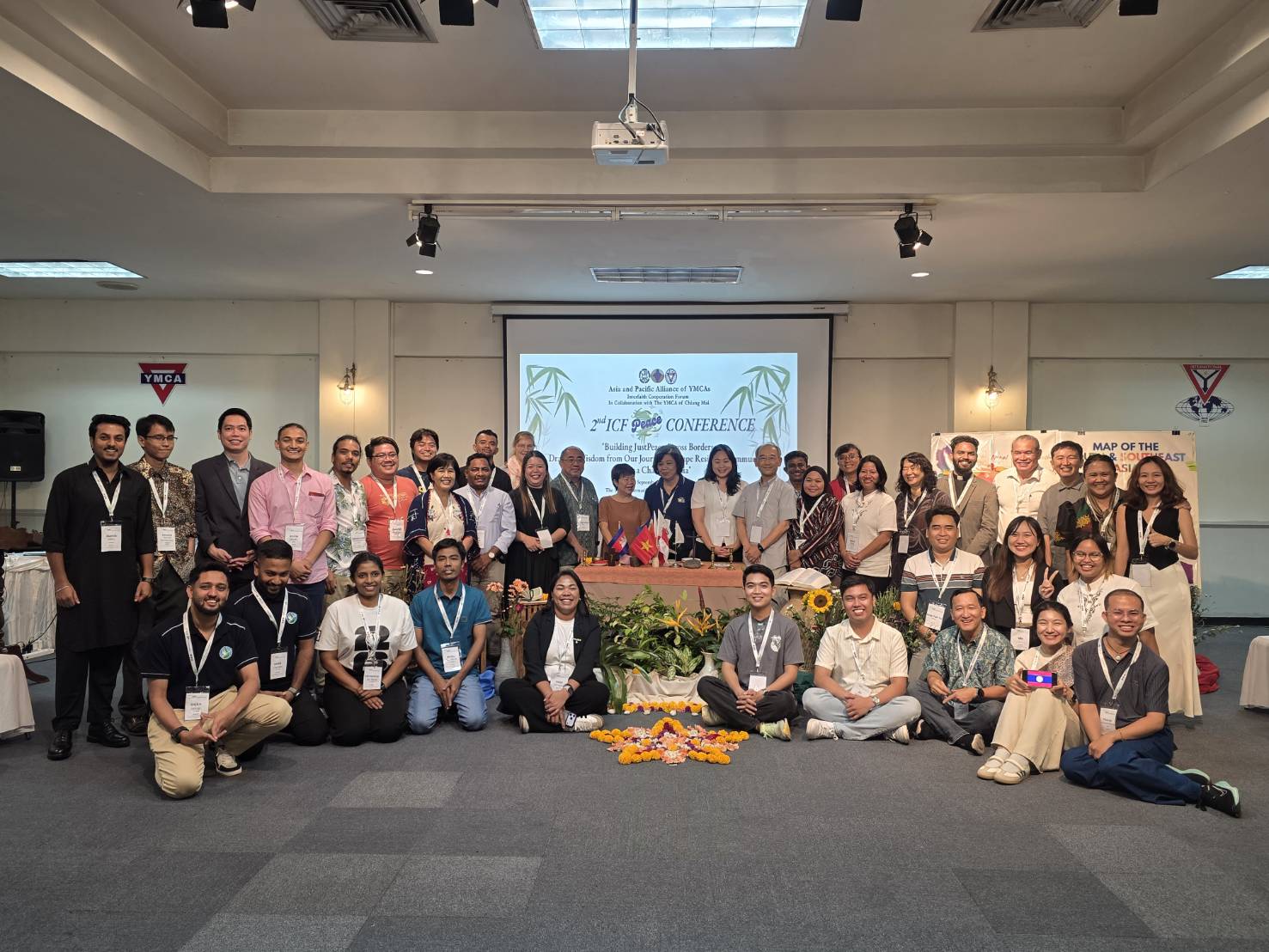
2nd ICF Peace Conference Statement
2nd Interfaith Cooperation Forum (ICF) Peace Conference 18–20 September 2026 at the YMCA International Hotel Chiang Mai, Thailand
Conference Statement
From 18 to 20 September, the 2nd ICF Peace Conference brought together 40 participants, including ICF alumni, peace practitioners, and APAY and YMCA staff, from 16 countries: Bangladesh, Cambodia, Hong Kong, India, Indonesia, Laos, Malaysia, Myanmar, Nepal, Pakistan, the Philippines, South Korea, Sri Lanka, Thailand, Timor-Leste, and Vietnam. Held at the YMCA International Hotel in Chiang Mai, Thailand, under the theme “Building JustPeace Across Borders: Drawing Wisdom from Our Journey to Shape Resilient Communities for a Changing Asia.”
The participants gathered for collective learning and sharing of ideas through panel discussions, dialogue, and reflections, where participants reflected on their peacebuilding journeys, explored pressing and emerging justice and peace issues and concerns affecting the Asian region, including the building of resilient communities, climate justice, and the increasingly significant role of artificial intelligence and social media in peacebuilding.
A crucial part of the conference was the recommitment by its participants to ICF’s shared values of JustPeace and to their collective vision for how the ICF movement can move forward together.
With this shared commitment, the participants issued a “Call for JustPeace” and “Call for Continued Support for the ICF Movement from the Asia and Pacific Alliance of YMCAs”.
A CALL FOR JUSTPEACE
We reaffirm our commitment to the values and mission of the ICF, and to the ongoing pursuit of JustPeace across Asia and beyond.
We affirm that peace without justice is not true peace. JustPeace requires dignity, equity, accountability, and the transformation of structures that produce violence and exclusion.
In the face of the escalating climate crisis, we call on governments, faith communities, civil society, and local institutions not only to make promises but also to develop and work with affected communities to fund, invest in, and implement concrete action plans that protect them and help them achieve dignity and justice. Those who have contributed least to the climate crisis are too often the ones who suffer its gravest consequences.
We strongly denounce the repeated expectation that vulnerable communities must simply become more “resilient” in times of crisis, while systems of support remain inadequate and unjust. Resilience must not be romanticized. Communities should not be asked to endure endless suffering without meaningful structural change, resources, protection, and accountability—if communities adapt, governments must themselves adapt.
We express alarm and concern about the proliferation of misinformation and hate speech on social media, particularly in the era of Artificial Intelligence (AI). We urge caution and education to encourage responsible use of digital platforms and maximize them as tools to support peacebuilding efforts beyond the online sphere.
As participants of this conference, we commit ourselves to advancing JustPeace through interfaith solidarity, youth leadership, community-based action, and regional and international cooperation. We commit to utilizing our capacities to foster JustPeace. We commit to listening to the voices of those most affected, beyond mere solidarity online, but actual physical presence and engagement on the ground — communicating, challenging systems of injustice, nurturing healing and dialogue, and working together to chase our dreams for peace.
A CALL FOR CONTINUED SUPPORT FOR THE ICF FROM APAY
Through the sharing of success stories and the tangible impacts of the project, in the backdrop of geopolitical, socio-religious, economic, and climate crises in the region, and consistent with the keynote statement of the immediate past General Secretary Mr. Nam Boo Won, the conference recognized a clear and compelling need to continue the work and mission of ICF beyond the period of external funding.
The ICF Movement reaffirms its values and continuing commitment to interfaith initiatives for peace. At the same time, we call on the Asia and Pacific Alliance of YMCAs (APAY), under its new leadership, to reaffirm its institutional commitment to the ICF and its continuing work. Projects that are relevant to communities, such as this, must not end simply because external funding ends. As APAY’s new General Secretary, Mr. Chan Beng Seng, reaffirmed: “The ICF work must continue with or without funding.”
Therefore, we urge APAY to keep the project alive; continue its mission and vision for interfaith cooperation and peacebuilding; nurture its relationships and peacebuilding work within APAY structures; and provide appropriate internal resources and funding available to continue supporting its over two-decade-long but still-necessary project.
This call was also affirmed by the ICF Programme Committee, which reached the same conclusion at its final meeting a few days prior to the conference: What is needed is not the recreation of the project at its previous scale, but APAY’s willingness and commitment to adapt, institutionalize and continue engaging with the ICF Alumni, peace practitioners and partner YMCAs.
The conference also acknowledges that ICF is a project of APAY and therefore does not have the legal authority or institutional capacity to directly approach and engage potential donors on behalf of the project. Thus, we request APAY to explore possible external funding partnerships and opportunities, including support from within the wider YMCA networks.
We make this call in the confidence that the work of the ICF will continue, and we commit ourselves to it. We record our gratitude to APAY, to Bread for the World, the ICF Program Committee, alumni, and all individuals and organizations who have accompanied and supported the ICF peacebuilding work for more than two decades.
We hereby adopt this Statement on 20 September 2026 in Chiang Mai, Thailand.